
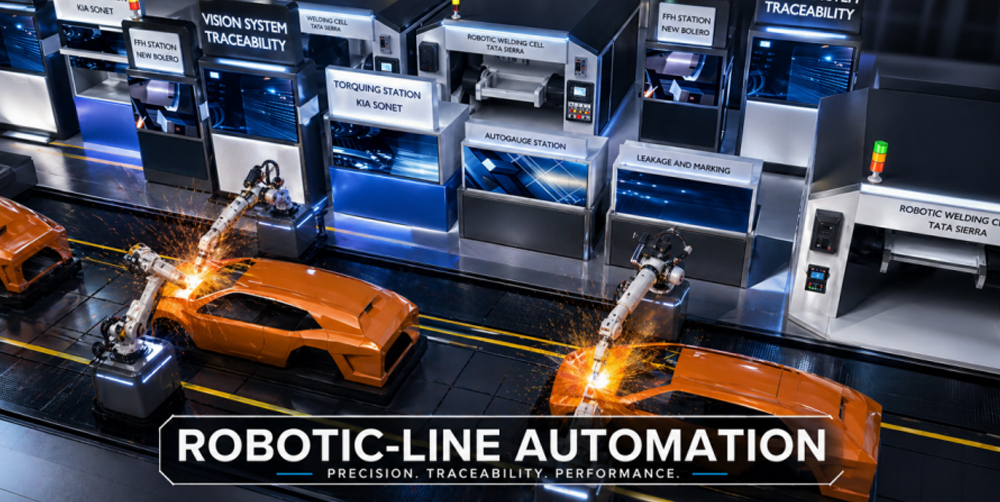
The automotive manufacturing industry continues to evolve toward higher precision, faster production rates, improved repeatability, and intelligent automation-driven manufacturing ecosystems. Among the most critical stages in vehicle production is the Body in White (BIW) process, the phase where sheet metal components are welded together to form the structural body of the vehicle before painting and final assembly.
At Electrodigit Automation & Robotics, we work across industrial automation systems, robotic applications, welding automation, fixtures, and process-oriented engineering solutions. As part of our technical visualization and engineering understanding initiatives, we developed a conceptual 3D simulation demonstrating an automotive BIW robotic welding line environment using industrial robotic automation principles.
"Automotive BIW automation combines robotics, motion engineering, manufacturing precision, control systems, and intelligent production planning to achieve high-efficiency manufacturing operations."
In automotive manufacturing, Body in White (BIW) refers to the stage where the vehicle’s sheet metal body components are assembled and welded together before paint, trim, drivetrain, electronics, and interiors are installed.
BIW manufacturing typically includes spot welding operations, MIG/TIG welding applications, robotic joining processes, structural assembly stations, fixture-based positioning systems, conveyorized body transfer systems, and robotic handling with automation integration.
Industrial robotics has become central to automotive body manufacturing due to its ability to perform repetitive welding operations with exceptional consistency and precision.
In a typical BIW environment, multi-axis industrial robots are deployed for spot welding, material handling, part transfer, seam welding, inspection assistance, and coordinated motion operations.
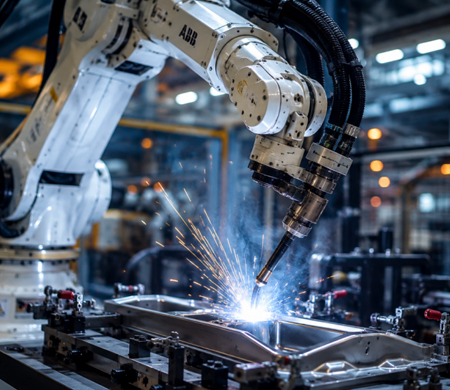
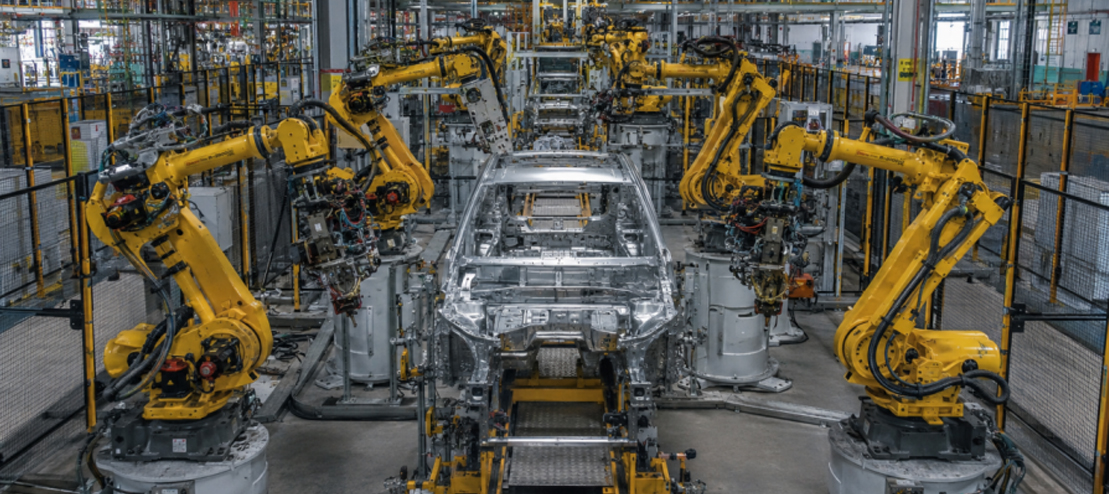
Although often used interchangeably, robotic welding cells and robotic line automation systems differ significantly in scope and manufacturing integration.
A robotic welding cell is generally an isolated automation unit designed for a specific operation or component. These systems commonly include one or multiple robots, dedicated fixture setups, localized PLC control, and specific welding applications.
Robotic line automation systems are larger integrated manufacturing ecosystems involving multiple synchronized stations, conveyorized transfer systems, centralized PLC architecture, sensor integration, process synchronization, and multi-stage welding sequences.
In automotive manufacturing, cycle time is one of the most critical production parameters. Efficient cycle time management directly impacts production output, throughput capacity, equipment utilization, manufacturing cost efficiency, and production planning.
Repeatability defines the robot’s ability to return to the same programmed position consistently over repeated cycles. High repeatability is essential for weld consistency, dimensional accuracy, fixture alignment, and structural integrity.
Fixtures ensure accurate positioning and clamping of automotive components during welding operations, maintaining geometric accuracy, process consistency, and weld accessibility.
PLC systems coordinate automation logic throughout the manufacturing line, including robotic communication, sensor monitoring, conveyor control, process sequencing, interlocks, and station synchronization.
Conveyor systems enable automated movement of vehicle bodies and subassemblies between production stations, supporting continuous production flow, reduced manual handling, and higher operational efficiency.
As part of our engineering-focused visualization initiative, Electrodigit Automation & Robotics developed a conceptual 3D Blender-based simulation representing an automotive BIW robotic welding line environment.
The visualization demonstrates multi-robot coordination, 6-axis robotic movement, conveyorized production flow, automotive body welding concepts, industrial automation workflow visualization, and robotic process sequencing.
Automotive manufacturing is rapidly transitioning toward digitally connected and intelligent production ecosystems. Key future trends include Industry 4.0 integration, Digital Twin simulation engineering, AI-assisted manufacturing analytics, flexible robotic manufacturing, and smart factory synchronization.
Automotive BIW automation represents a convergence of robotics, motion engineering, manufacturing precision, control systems, and intelligent production planning.
As automotive manufacturing continues evolving toward smarter and more connected production ecosystems, robotic line automation, synchronized control systems, and engineering-driven process integration will remain essential to achieving high-efficiency manufacturing operations.
At Electrodigit Automation & Robotics, we continue exploring industrial automation technologies, robotic applications, welding automation concepts, and engineering-focused manufacturing solutions aligned with the future of smart industrial production.

Transforming Manufacturing with Intelligent Systems Delivering Precision-Driven Results Every Time

